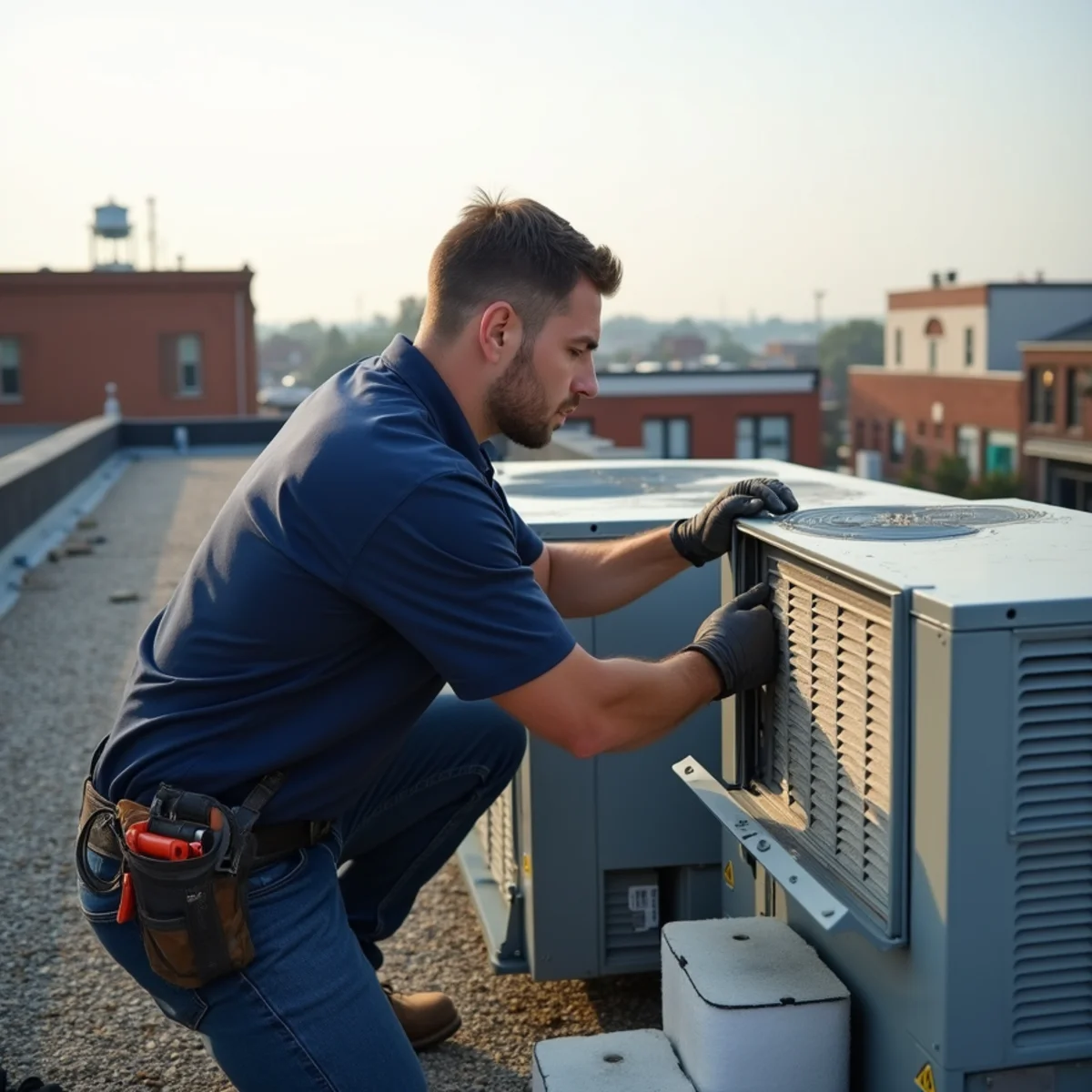
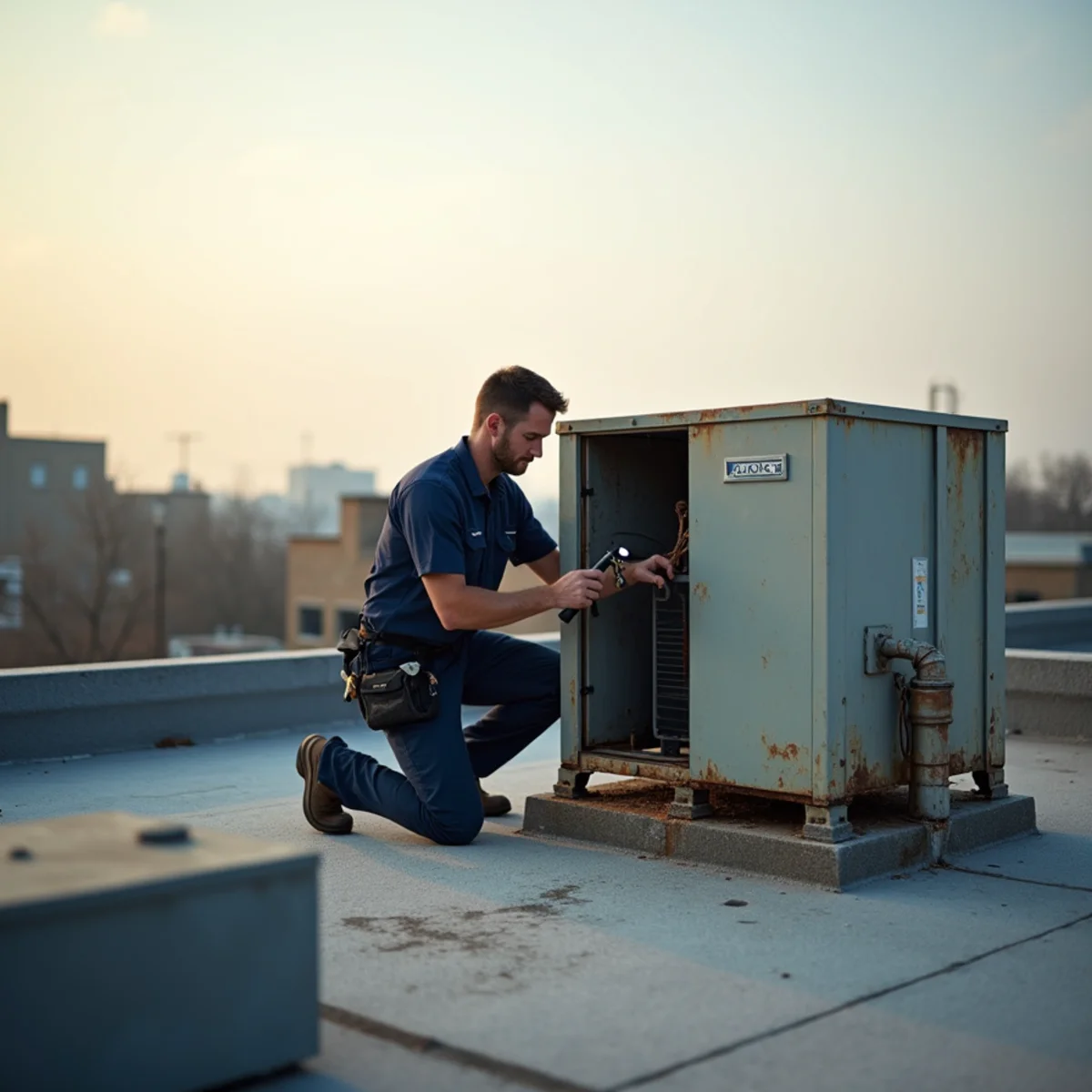
Short answer: Repair a small-business rooftop unit when it is under about ten years old, the failed part is minor, and the cabinet, coils and heat exchanger are sound. Replace it when it is around fifteen years or older, runs on R-22, has a failed compressor or cracked heat exchanger, or when a repair nears half the replacement cost.
When the rooftop unit over your shop or office fails, you need the space comfortable again quickly, and you need to decide whether to put money into the old unit or replace it. Both can be the right call. The wrong call is making the decision in a panic with no information.
This article covers light commercial packaged rooftop units (RTUs): the gas-electric packs and heat pump packs you see on small offices, strip-center shops, churches and restaurants. Here is how we walk owners through the choice.
Start With an Honest Diagnosis
A good decision starts with knowing exactly what failed and what shape the rest of the unit is in. A failed condenser fan motor on an otherwise solid unit is a very different situation from a failed compressor on a unit with a rusted-through base pan.
A proper diagnostic looks beyond the part that quit. It should cover the compressor, the condition of the coils, the heat exchanger on gas units, the cabinet and base pan, the roof curb seal and the refrigerant type. You should get that in writing, with a price for the repair and a price for replacement side by side.
Factors That Point Toward Repair or Replacement
| Factor | Leans toward repair | Leans toward replacement |
|---|---|---|
| Age | Under about 10 years, with a good service history | Around 15 years or older, with frequent recent repairs |
| Failed part | Capacitor, contactor, fan motor, igniter, belt, control board | Compressor on an old unit, cracked heat exchanger, leaking coils |
| Refrigerant | R-410A system with a small, fixable leak | R-22 system needing refrigerant, which is scarce and expensive |
| Cabinet condition | Solid panels, intact base pan, sound curb seal | Rusted base pan, water getting into the building |
| Performance | Keeps the space comfortable when working | Could never keep up, or the space use has changed |
| Operating cost | Energy bills stable and reasonable | Rising energy and repair costs year after year |
The 50 percent rule of thumb
A common guideline: if a repair costs more than about half of what replacement would, and the unit is past the middle of its expected life, replacement is usually the better investment. Rooftop units exposed to North Carolina sun and summer storms often last roughly 15 to 20 years with good maintenance, and less without it.
Cracked heat exchangers are a safety issue
On gas packs, a cracked or rusted-through heat exchanger can let combustion gases into the airstream. That is not a repair we will leave running. Replacing just the heat exchanger is sometimes possible, but on an older unit the labor and parts often make full replacement the more sensible choice.
The Refrigerant Question
Older rooftop units often run on R-22, which is no longer produced in the U.S. for new use. Any R-22 still available is reclaimed stock and expensive. If an R-22 unit has a leak, that is usually a strong vote for replacement.
The industry is also moving away from R-410A in new equipment toward lower-impact refrigerants such as R-454B and R-32. Existing R-410A units can still be serviced, and refrigerant remains available, but it is worth factoring in when you are deciding whether to put major money into an older 410A unit. Any contractor handling refrigerant must hold EPA Section 608 certification.
Planning a Rooftop Replacement
Replacing an RTU is more involved than a residential swap. Here is what goes into a typical job:
- Load and sizing review, especially if the space use has changed (an office that became a gym, a retail space that became a restaurant).
- Curb assessment: new units rarely match the old curb, so a curb adapter or new curb is often needed, along with roof flashing.
- Crane or lift scheduling to remove the old unit and set the new one.
- Permits and inspection through the local building department.
- Electrical and gas connection checks, including disconnect sizing.
- Startup, charge verification, economizer and thermostat setup, and a written record of readings.
Most replacements can be scheduled early in the morning or on a weekend to avoid closing the business. Talk to your accountant about how the equipment cost is treated for taxes; commercial HVAC replacements may have depreciation options, and the rules change.
Greensboro and Guilford County Buildings
Much of the light commercial stock in Greensboro and across Guilford County was built or renovated decades ago, and many of the rooftop units on older strip centers and small office buildings are near or past the end of their service life. Some still run on R-22. Those are the buildings where the repair-or-replace question comes up most, and where a planned replacement usually beats waiting for a July failure.
If your unit fails outright, our emergency HVAC repair service can get you running or stabilized while you weigh options. If you are ready to plan ahead, we can quote a replacement alongside the repair so you can compare real numbers, and we also handle new system installations for smaller buildings with split systems.
Rooftop unit decisions: myths vs. facts
Myth: A new compressor makes an old rooftop unit as good as new.
Fact: The compressor is one part of a system that aged together. Coils, fan motors, contactors, controls and the cabinet are just as old. A burned-out compressor can also leave acid and debris in the refrigerant circuit, so a proper replacement needs cleanup, a new filter drier and careful evacuation. On a unit well into its second decade, that combined risk often favors replacement.
Myth: It's cheaper to wait until the unit dies completely.
Fact: Waiting keeps money in hand now, but a failure picks its own timing, usually during peak heat when contractors, cranes and equipment are hardest to schedule. Some commercial units aren't stocked locally and take time to arrive. A planned replacement lets you choose the day, compare quotes calmly and avoid days of lost business.
Myth: Heat pump packs can't handle heating a North Carolina business.
Fact: Piedmont winters are mild enough that packaged heat pumps heat many offices and shops well, with electric backup for the coldest mornings. Gas packs make more sense where gas is already at the building, heating loads are high, or the space has large doors opening all day. The right choice depends on the building, fuel availability and utility rates.
Myth: Adding refrigerant each summer is a normal part of owning a rooftop unit.
Fact: A sealed refrigerant circuit shouldn't need regular recharging. Needing a charge every year means there's a leak, and each top-off adds cost without fixing anything. Knowingly venting refrigerant is prohibited under federal rules, so a certified tech should search for the leak and give you a written repair price before any more refrigerant goes in.
Replacing rooftop units in Greensboro and Guilford County
Location on the map changes how a rooftop replacement gets planned across Guilford.
In downtown Greensboro along Elm Street, about 30 to 35 minutes from our base, shops and restaurants sit in older buildings where rooftop units have been patched for years. Crane placement on a busy street, roof access through an adjoining building and timing around dinner service all shape the schedule. For a restaurant, an early-morning change-out on a slow weekday usually works better than a weekend.
Across the rest of Guilford County, a few practical points apply:
- Permits run through Greensboro's or High Point's own inspections office inside those cities, and through Guilford County for unincorporated addresses.
- Storefronts in the eastern towns near Whitsett and McLeansville are about 15 minutes from us, so a failed unit there can often be stabilized the same day while you weigh options.
- Strip centers with several units on one roof are worth assessing together, since replacing them in one crane visit can simplify scheduling.
Our light commercial HVAC work covers the assessment, the quote and the change-out.
From the field: the hidden costs in an RTU change-out
The unit itself is only part of a rooftop replacement. The items that surprise owners are usually on the roof and in the paperwork, so Jesse raises them before the quote, not after.
- The roof warranty. Cutting, flashing or adapting a curb on a roof that is still under a roofing warranty may require the roofer's involvement. A call to your roofer before the job protects that coverage.
- Electrical differences. A new unit's minimum circuit ampacity and maximum breaker size can differ from the old one's. The disconnect and breaker have to match the new nameplate.
- Crane logistics. A crane on a tight downtown street or a strip-center lot may need a permit or a lane closure, which affects timing more than the install itself.
- Code upgrades. A new unit may need features the old one never had, such as an economizer or updated controls, depending on its size and the current energy code.
A common temptation with an old R-22 unit is a "drop-in" replacement refrigerant. It can buy a season, but the replacement refrigerants don't behave exactly like R-22, capacity often drops, and it doesn't fix the leak that emptied the system. We treat it as a stopgap, not a plan.
If the building's use has changed, replacement is also the chance to right-size. Downsizing an oversized unit can improve humidity control in a small shop.
Get Both Options in Writing
No one should pressure you into a new rooftop unit if a repair makes sense, and no one should keep patching a unit that is costing you more every year. Ask for a diagnosis, a repair price and a replacement price, then make the call with facts. Schedule an assessment through our light commercial HVAC service and we will give you both options in writing.
Frequently asked questions
How long does a commercial rooftop unit last in North Carolina?
With regular maintenance, a light commercial RTU often lasts about 15 to 20 years. Units that go years without coil cleaning, filter changes or drain service tend to fail sooner. Coastal and industrial exposure shortens life further, but most Piedmont units fall in that range.
Can a rooftop unit be replaced without closing my business?
Usually, yes. Many replacements can be done in a single day, and we can often schedule the crane and change-out early in the morning or on a weekend. The space may be without heat or cooling for part of the day, so planning ahead is easier than replacing after a failure.
Should I replace an R-22 rooftop unit that still works?
Not necessarily. If it runs well and does not leak, keep maintaining it. But start budgeting for replacement, because a leak or compressor failure will make repair expensive and possibly impractical. Planning the replacement on your schedule is almost always cheaper than doing it in an emergency.
Local service for this topic

Written by Littlejohn HVAC Solutions, LLC. Owner Jesse Littlejohn is a licensed HVAC professional serving Burlington and Alamance County. About us