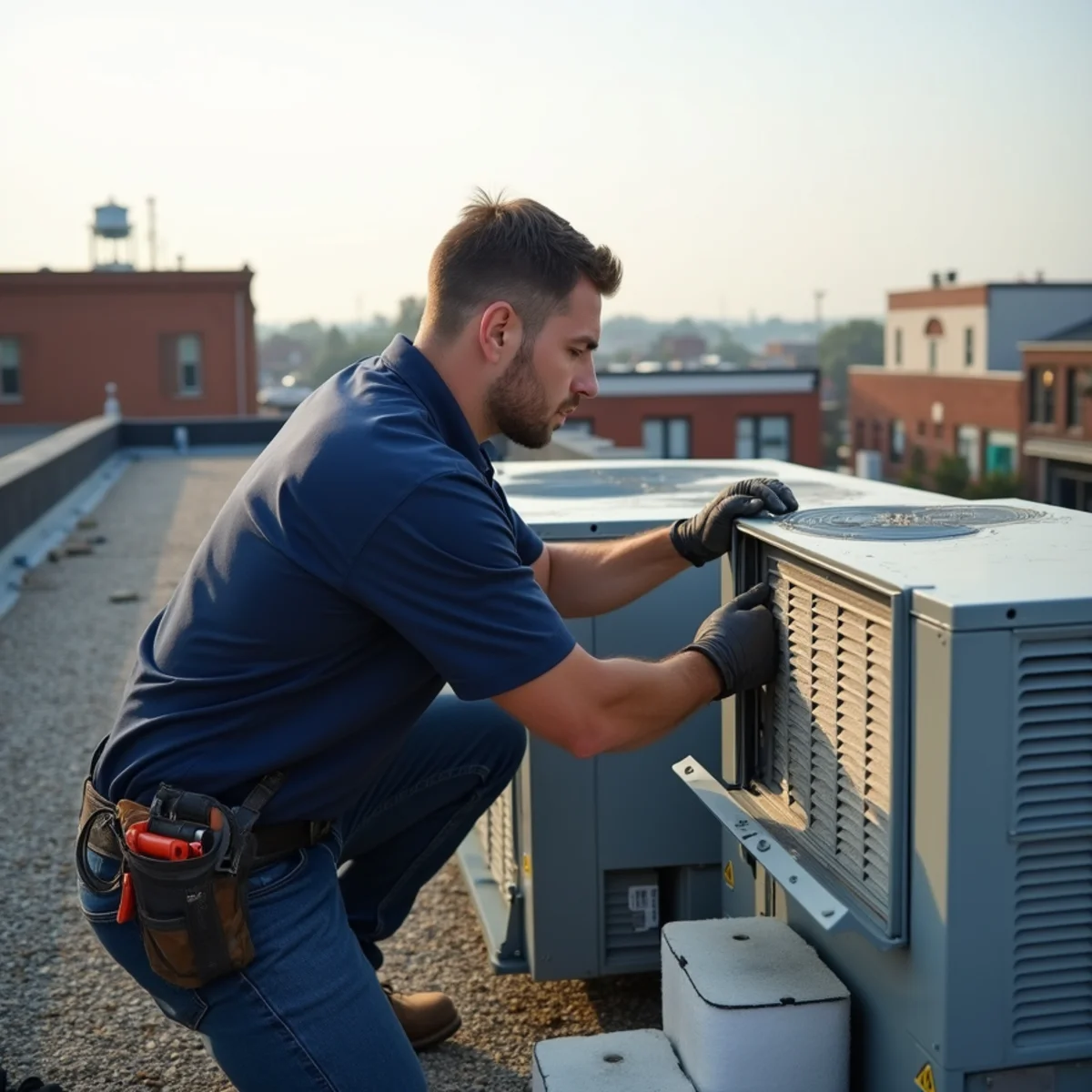
Short answer: A spring AC tune-up checklist for Burlington, NC should include a new filter, a rinsed condenser coil, a flushed condensate drain, and technician tests of the capacitor, contactor, refrigerant charge, temperature split and electrical connections. Book it in March or April, before the first 90-degree week fills every contractor's schedule and pollen coats the coil.
The first 90-degree week in Burlington usually shows up in May or early June, and it finds every weak part in an air conditioner at once. Capacitors that were borderline last fall give out. Drains that grew algae over the winter back up. The service calls pile up, and every contractor in the county is busy.
A spring tune-up moves most of those failures to a cool day in March or April, when a fix is calm and scheduled instead of urgent. Here is the checklist we use, split into what you can handle and what needs a technician with gauges and a meter.
What You Can Do Yourself
None of these require tools beyond a garden hose and a flashlight. Turn the system off at the thermostat before touching anything at the outdoor unit.
- Change the filter. Start the season with a clean one. Spring pollen loads filters fast, so plan to check it again in a few weeks.
- Clear around the condenser. Pull back shrubs, leaves and pine straw so there are at least two feet of open space on all sides.
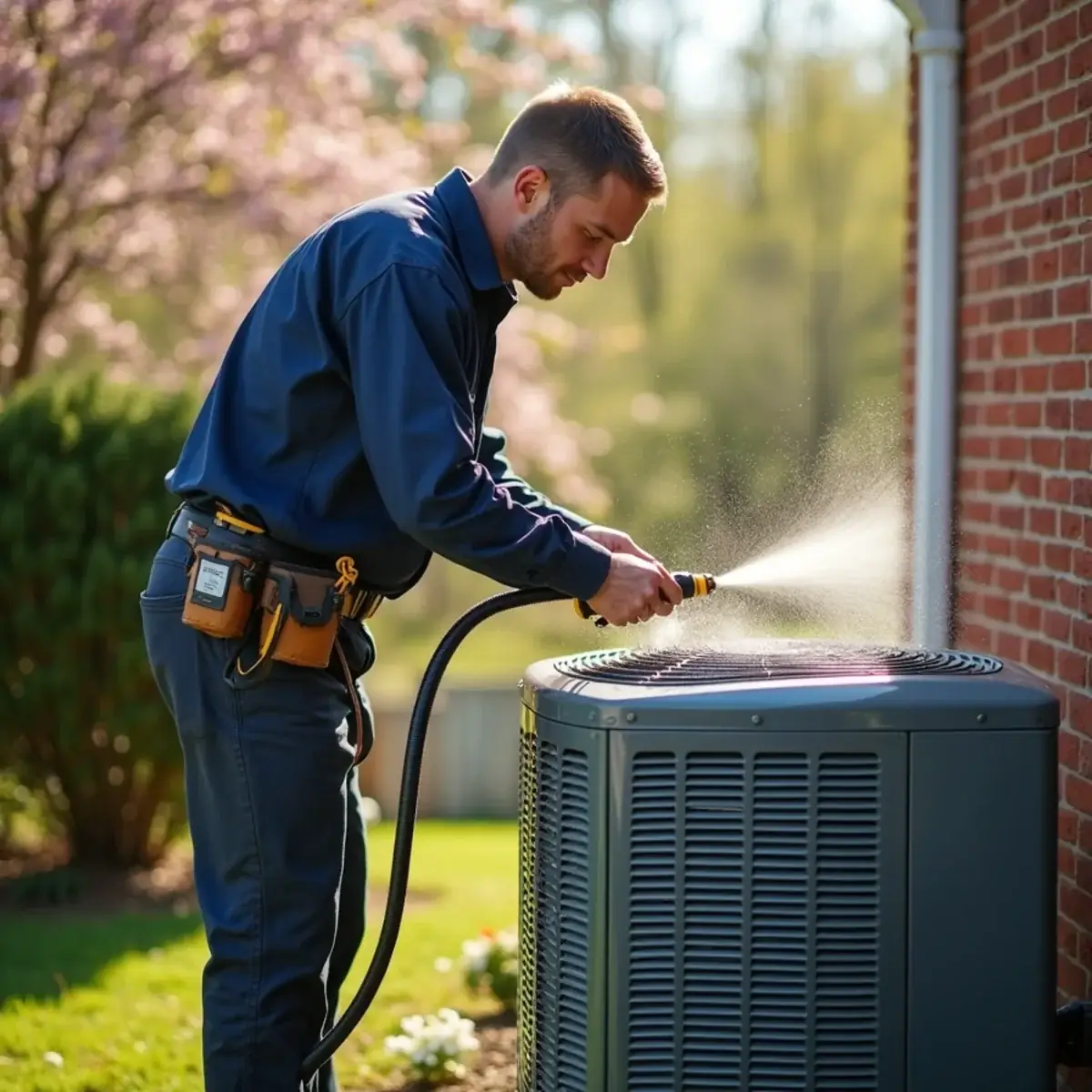
- Rinse the outdoor coil gently. A garden hose on a soft spray, from the inside out if you can reach, or straight in from outside. Never a pressure washer; it flattens the fins.
- Look at the refrigerant line insulation. The foam on the larger copper line should be intact. Cracked or missing insulation costs efficiency and can drip inside.
- Find the condensate drain outlet. Know where it exits the house so you can see whether it is dripping once the AC runs.
- Test run the system. On a mild day, set it to cool a few degrees below room temperature and make sure the outdoor fan and compressor start.
What a Technician Should Check
A real tune-up takes longer than ten minutes and involves measurements, not just a look. If a visit ends with a sticker on the unit and no numbers, you did not get much. Here is what our AC maintenance visit covers.
| Checklist item | What the tech does | Why it matters |
|---|---|---|
| Run capacitor | Tests microfarad rating against the label | Weak capacitors are the top cause of no-cool calls in summer |
| Contactor | Inspects contacts for pitting and burning | Pitted contacts cause chattering, hard starts or a unit that will not shut off |
| Refrigerant charge | Measures superheat or subcooling with gauges or probes | Low charge usually means a leak; wrong charge costs efficiency and strains the compressor |
| Temperature split | Compares return and supply air temperatures | A quick check of whether the system is actually removing heat |
| Condensate drain | Flushes the line, treats for algae, tests the float switch | Clogged drains cause ceiling stains and water-damaged floors |
| Electrical connections | Tightens terminals, checks wire insulation and amp draw | Loose connections run hot and fail under peak load |
| Indoor coil and blower | Inspects coil face and blower wheel for dirt buildup | A dirty coil or wheel cuts airflow and can freeze the coil |
| Thermostat | Confirms calibration, settings and wiring | Wrong settings can make a working system look broken |
Why charge readings matter
Refrigerant does not get used up. If a system is low, it is leaking somewhere. A good tech will tell you that plainly instead of topping it off every spring and sending you on your way. Sometimes the leak is small and a repair is worth it; sometimes it is in an old evaporator coil and the math points toward bigger decisions. Either way, you should know.
Heat pumps need the same attention
If your home has a heat pump, the outdoor unit worked all winter too. The reversing valve, defrost controls and outdoor coil all get extra wear. A spring check on a heat pump system looks at the cooling side and confirms nothing from the heating season needs follow-up.
The Burlington Angle: Pollen, Humidity and Age
Spring in the Piedmont coats everything in pine pollen, and your condenser coil catches plenty of it along with cottonwood fluff and grass clippings. A coated coil cannot shed heat, which drives up head pressure, power use and compressor temperature just as summer loads arrive.
Our humidity is the other factor. Condensate drains here work hard from May through September, and the warm, wet line is a perfect place for algae. Many of the water-in-the-ceiling calls we see in July trace back to a drain that could have been flushed in April.
Around Elon, plenty of homes near campus are rentals or older brick ranches with systems that have been patched more than maintained. Out toward Gibsonville, we see a mix of older homes and newer subdivisions. The checklist is the same, but older systems deserve a closer look at capacitors, contactors and drain pans, since those parts age first.
When a Tune-Up Turns Up a Problem
A good tune-up sometimes finds something: a capacitor reading 20 percent low, a slow leak, a rusted drain pan. That is the point. You get written options and a price before any repair, with no pressure to replace what can be fixed. If the unit is already struggling, we will handle it as an AC repair visit and explain what failed and why.
Spring AC prep: myths vs. facts
Myth: If the AC ran fine last fall, it'll be ready for summer.
Fact: A lot happens to an idle outdoor unit over winter. Fire ants pack into contactors, wasps build under the top panel, and mice chew low-voltage wiring and line set insulation. Capacitors also lose capacity with age whether the unit runs or not. A spring test run and inspection finds those problems before the first hot week puts the full load on them.
Myth: Setting the thermostat to 60 cools the house down faster.
Fact: A single-stage air conditioner delivers the same cooling whether the target is 74 or 60; it just runs longer before stopping. Setting it far lower doesn't speed anything up and can let the indoor coil get cold enough to freeze if airflow is marginal. Pick the temperature you actually want and let the system work steadily toward it.
Myth: Covering the outdoor unit all winter keeps it in better shape.
Fact: A heat pump runs all winter and must never be covered. On a cooling-only condenser, a full wrap traps moisture against the coil and cabinet and gives rodents a sheltered place to nest. The unit is built to sit outdoors. At most, a board or breathable cap over the top keeps leaves out without sealing the sides.
Myth: Pouring straight bleach down the condensate line is the best way to clean it.
Fact: Strong bleach can corrode some metal drain pans and coil components, and it doesn't clear a heavy clog anyway. Many manufacturers suggest mild distilled vinegar or approved drain tablets as routine treatment. A packed line needs to be vacuumed or flushed from a cleanout, and the float switch tested afterward so a future backup shuts the system off.
Spring tune-up timing in Elon and Gibsonville
Two neighboring towns, two different reasons to get the visit on the calendar early.
In Elon, where many houses near campus are rentals, the real deadline isn't the first hot week; it's August move-in. Landlords do best scheduling in May or June while houses are half-empty and access is easy. We note each unit's filter size, set thermostat limits the owner controls and leave a written summary per property.
Out in Gibsonville's subdivisions toward Whitsett, a lot of homes from the 1990s and 2000s put the air handler in the attic. A spring tune-up on those systems adds a few attic-specific checks:
- Looking for water or rust in the secondary drain pan, which means the main line has already backed up.
- Confirming a float switch will shut the system down before the ceiling below gets stained.
- Checking the original outdoor fan motor, which on many of these heat pumps is near the end of its life.
Elon is about 10 minutes from our base and Gibsonville about 15, so if a tune-up turns up a failed part, our same-day HVAC service usually handles the repair without a second trip.
From the field: what a tune-up can and can't promise
A tune-up lowers the odds of a July breakdown. It doesn't eliminate them, and a few honest details help set expectations.
- Capacitors fail gradually, then suddenly. A capacitor reading a little under its rating may run all summer or quit on the first hot afternoon. Jesse shows you the reading and lets you decide whether to replace it now or watch it.
- Coil cleaners are not always better than water. Many modern outdoor coils, especially all-aluminum microchannel designs, can be damaged by harsh cleaners. A thorough low-pressure rinse is often the right call, with a manufacturer-approved cleaner saved for heavy buildup.
- The indoor coil is often sealed in its case. On many systems it can't be fully cleaned without opening refrigerant or duct connections. We inspect what we can reach and tell you if a deeper cleaning is worth the labor.
- Hard-start kits are a patch. On an older compressor that struggles to start, a hard-start kit can buy time. It won't fix a compressor that's wearing out, and we'll say so.
If you're told your system needs refrigerant every spring, ask where the leak is. Repeat top-offs cost more over time than finding the leak once. Those findings and readings are part of every HVAC maintenance visit we do.
Book Your Spring Tune-Up Early
March and April are the best months to get ahead of summer in Alamance and eastern Guilford counties. Schedule your spring AC maintenance and tune-up with Jesse while the weather is mild and the schedule is open, and head into June knowing your system has been tested, not just glanced at.
Frequently asked questions
How long does a spring AC tune-up take?
A thorough tune-up on a typical split system takes roughly an hour, sometimes longer if the coil needs a real cleaning or the drain is badly clogged. If a visit takes fifteen minutes and produces no readings, it probably was not much more than a visual check.
Is a tune-up worth it on a newer system?
Yes. Newer systems still collect pollen on the coil, grow algae in the drain and loosen electrical connections. Many manufacturers also expect regular maintenance as part of their coverage terms, so it is worth reading your registration paperwork and keeping service records.
Can I just hose off my outdoor unit and skip the tech?
Rinsing the coil helps, and you should do it. But a hose will not tell you that a capacitor is weak, the refrigerant charge is off or a contactor is pitted. Those are the parts that fail on the hottest day, and testing them takes a meter and gauges.
Local service for this topic

Written by Littlejohn HVAC Solutions, LLC. Owner Jesse Littlejohn is a licensed HVAC professional serving Burlington and Alamance County. About us